What is Cinderella's two-resource loop?
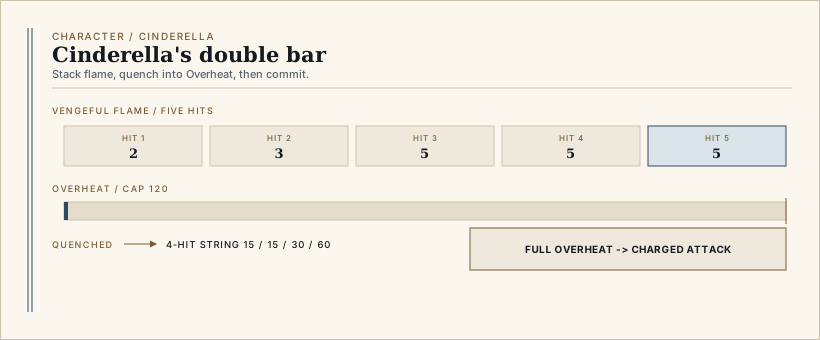
Cinderella is the clearest example of a double-bar kit. Double-Quenched Blade builds Vengeful Flame on every hit of the normal five-hit string, with the per-hit gains at 2 / 3 / 5 / 5 / 5. The Quenched state swaps that string for a four-hit version that builds Overheat instead, at 15 / 15 / 30 / 60 per hit. Both bars matter, but they are spent differently.
The normal string is the setup bar. Vengeful Flame is generated by attacking and by the pursuit attack, and the charged attack adds 10 more. The Overheat bar is the payoff bar: it caps at 120, and a full bar is what turns the charged attack into the empowered version. The practical loop is to bank Vengeful Flame, move into Quenched, fill Overheat, then spend it.
What changes in the Quenched state?
The basic attack becomes a four-hit string instead of five. Each hit grants Overheat — 15, 15, 30 and 60 — and the fourth hit also makes her immune to damage for that hit. That immunity is the reason the state is worth using defensively as well as offensively: the last hit of the string is a free window in the middle of a boss combo.
The CBT2 data names the state but does not document the exact trigger that enters it. We are not going to invent one. What is documented is the behaviour once you are in it: four hits, the Overheat gains above, and damage immunity on hit four.
How does a full Overheat bar change the charged attack?
At 120 Overheat, the charged attack becomes the empowered charged attack and consumes the whole bar. That makes the cap a planning number, not a passive stat: you want to enter the charged input with a full bar, because a partial bar is not converted into the same result.
Overheat also arrives from sources outside the Quenched string. A perfect dodge followed by the ranged volley adds 25 Overheat. That is the fastest single gain in the kit, and it means a defensive read can fund the next empowered attack without a full Quenched string.
Which inputs shortcut the five-hit string?
Three shortcuts are documented. A parry lets the next basic attack start at hit three. After hit four, pressing the basic attack button fires the Charged Shot. A perfect dodge lets the next basic attack perform the ranged volley and add 25 Overheat. The pursuit attack adds 2 Vengeful Flame, and the charged attack adds 10 while also allowing a link back to hit three.
| Input | Effect |
|---|---|
| Parry, then basic | Starts at hit 3 |
| After hit 4, basic | Charged Shot |
| Perfect dodge, then basic | Ranged volley; +25 Overheat |
| Charged attack | +10 Vengeful Flame; can link to hit 3 |
| Pursuit attack | +2 Vengeful Flame |
The pattern to learn is parry into hit three, then play out hits four and five. That is the cleanest way to keep the string moving without spending a dodge on a yellow-ring attack. The full parry and dodge vocabulary is in the combat guide.
How much damage do her hits deal?
The five-hit string climbs steadily and then jumps on the last hit. Hit five is 78.48%, roughly twice the value of hit four. The earlier hits are not filler, because they are what generate the Vengeful Flame that pays for the rest of the kit.
| Move | CBT2 value |
|---|---|
| Hit 1 | 28.74% |
| Hit 2 | 38.70% |
| Hit 3 | 39.81% |
| Hit 4 | 45.32% |
| Hit 5 | 78.48% |
All five values are CBT2 test numbers. The launch build may retune them, so use the ratios rather than the exact percentages when you plan a rotation.
How do you clear the pumpkin-carriage phase?
Phase one is the burning pumpkin carriage. The body inside is completely immune, so damage on the character model does nothing. The objective is the carriage itself: destroy the vehicle while avoiding the fan-shaped and ring-shaped area attacks that the carriage throws out.
This phase rewards target discipline more than damage. If your party keeps hitting the immune body, the bar never moves. Switch to the carriage, stay out of the painted areas, and treat the phase as a mechanics check rather than a DPS check.
How do you survive the second phase?
Phase two is the body form. Two attacks define it: a triple jump ground slam and a stomp grab that forces a quick-time input. The grab is not a parry check and not a dodge check — it is a QTE, so the correct response is to hit the prompted input rather than to roll away.
The triple slam is the attack to learn first. Count the impacts and move after the third, not after the first. Being knocked down leads into a crystal-shoe showcase sequence, which is a presentation beat rather than a failure state you can skip. Cinderella is the game's first boss, so this fight is also the tutorial for reading large, heavily telegraphed animations.
How do you obtain Cinderella?
In CBT1 she was a day-2 sign-in gift, which is the only confirmed acquisition route in the data. She is a 5★ Ignis Outlaw with the epithet The Vengeful Ant and the combat role Striker DPS. No launch banner or free-unlock route has been announced for the global release.
For the rest of the roster and the other damage dealers, see the characters page, the Detective build and the Gratia build.
Common questions
Is Cinderella a ranged or melee character?
She is built as a ranged Ignis damage dealer, but her basic string is a close-range blade combo. The kit mixes both, which is why the charged shot and the perfect-dodge volley matter.
How do you enter the Quenched state?
The CBT2 data set names the state and its four-hit string but does not document the exact trigger. Any specific trigger claim without a source should be treated as unconfirmed.
Does Overheat carry between fights?
No published data covers carry-over. Treat each encounter as a fresh bar until the launch build documents otherwise.
Can you parry the boss grab?
No. The stomp grab forces a quick-time input in phase two, so it is neither a parry nor a dodge check.