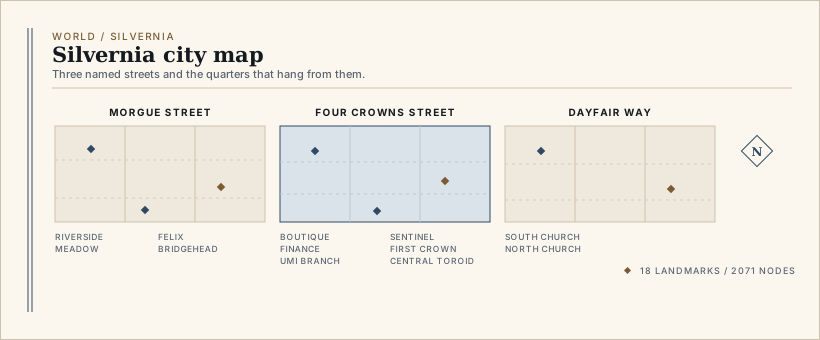
How is the Silvernia map organised?
By streets and quarters. A street is the top-level label on the map, and each street contains several named quarters with their own landmarks and collectibles. The pattern was visible in the first test with three streets and a few quarters, and the interactive map later filled in the rest. Names other than Morgue Street are provisional translations from English-language map data, so expect the in-game text at launch to differ in places.
| Street | Quarters named on the map |
|---|---|
| Morgue Street | Riverside, Felix, Meadow, Bridgehead |
| Four Crowns Street | Boutique, Sentinel, Finance, First Crown, UMI Branch, Central Toroid |
| Dayfair Way | South Church, North Church |
This is the same city described on the world and story page: the vertical social layers are clearest where a street changes from luxury to industry within a few blocks.
Where is the detective agency on the map?
S.T.A.T.S. sits on Morgue Street. The street's official name is confirmed, unlike most of the quarter names around it. In the story the agency was closed for the three years the Detective was away and reopened on their return, so it doubles as a landmark and a progress marker.
Morgue Street also holds the Riverside and Felix quarters, plus Meadow and Bridgehead. That makes it the most story-dense street in the current build: case scenes, the agency and several residential blocks all sit within it. If you are orienting yourself for the first time, learn this street before the others.
What is each street known for?
Four Crowns Street is the commercial and institutional spine. The Boutique quarter handles retail, Sentinel and Finance carry security and money, First Crown suggests the crown's own presence, the UMI Branch quarter belongs to the United Mining Industry, and the Central Toroid is the ring-shaped centre of the street. The mix is deliberate: money, law and industry share the same road.
Dayfair Way is the church side of the city, split into South Church and North Church quarters. It is the smallest of the three streets by named quarters, and it is where the religious thread of the setting surfaces. In between sits everything else — the residential edges, the docks at Riverside, and the rooftops that connect them.
What can you collect on the map?
Documents and documents-adjacent objects are the main collectible class. Confirmed examples include The Science of All Things volumes I to III and Understanding the Silverium Conspiracy, Part I. The same map data lists public notices, bank guides, exhibition posters, café pamphlets, trade-fair posters, appointment notices, brochures, notes and bookmarks.
- Volumes and treatises: The Science of All Things I–III; Understanding the Silverium Conspiracy, Part I.
- Official paper: River Constabulary Public Notice; Royal Bank Services Guide; Notice of Appointment.
- Posters and pamphlets: Silverium Craft Exhibition Poster; trade-fair poster; Solferino brochure; Voicepipe Café pamphlet.
- Personal traces: assorted notes, lost packages, letters and bookmark collectibles.
The CBT2 collectible loop was grouped into chests, lost packages, temporary commissions, high-risk persons, micro puzzles and district sweeps. The 2,071 resource-node figure and the 18-landmark figure are the interactive map's own counts, not official numbers, and they were re-checked unchanged in October 2026.
How do you traverse the city vertically?
Three tools do most of the work: a grapple for parkour pulls, rail slides for long horizontal runs, and the Silverium flying horse, a mechanical mount that glides and lets you dismount in mid-air. CBT2 also added a normal jump, which the first test lacked, and that single change opened up rooftops that used to be scenery.
Exploration is therefore three-dimensional. A landmark is often not on the street but above it, and the route between two quarters may run across roofs rather than along the road. If you are learning the movement set, the beginner guide covers the order to practise it in.
How much did the map grow between tests?
Substantially. The second test expanded the map to several times its first-test size and added chests, resident requests, small puzzles and random events to roads, rooftops and interiors. The interactive map's three-street, eleven-quarter, 18-landmark and 2,071-node layout is the CBT2 shape.
One caution about map advice: no district is locked behind a player level. Claims that districts unlock at fixed levels come from template articles and do not match the build. Exploration gates exist for district completion rewards, not for access.
Common questions
Are the quarter names official?
Only Morgue Street has a confirmed official name. The rest are translations from English map data and may change at launch.
How many landmarks are there?
A third-party interactive map counts 18. That is not an official total, and it may grow with later updates.
Is the city seamless or zone-based?
It is one connected city map, split into streets and quarters for navigation and completion tracking rather than by loading screens.
Do I need the flying horse to explore?
No. Grapple and rail routes cover most vertical gaps, but the horse makes long rooftop crossings much faster.