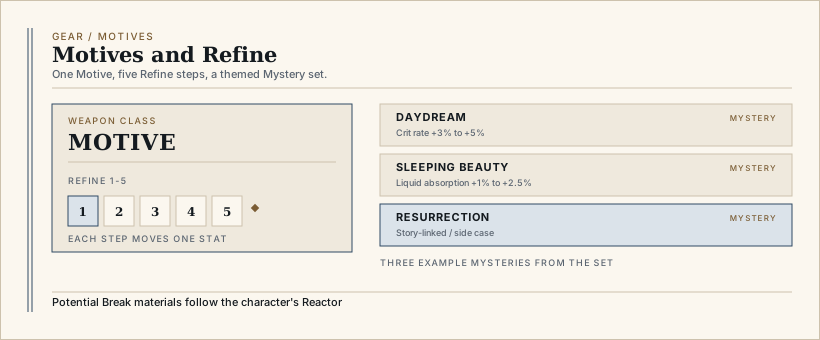
Why are weapons called Motives?
Because in this setting a weapon is an expression of what drives a character, not a piece of generic equipment. The official English term is Motives, and it covers the entire weapon class rather than a single item. When a character equips a Motive, they are equipping a small narrative object: a camera, a saw, a blade, a set of cards.
Mechanically, Motives work like weapons anywhere else. They carry stat lines, they have rarity, and they can be refined. The difference is in the packaging. Each character's set is themed to them, so the names read like short stories rather than like loot tables.
What is a Mystery set?
A Mystery is the individual weapon item inside a character's themed set, and the set as a whole is built from Mysteries. The naming is consistent: each item is "The X Mystery", and each one has a fixed stat identity. That means a character's set covers several different needs at once instead of repeating one stat six times.
The three stat families observed in CBT2 were crit rate, HP multiplier and liquid absorption. A set usually mixes them, so the choice inside a character's set is about which mix you want rather than which weapon tier is higher.
What are Grimm's seven Mysteries?
Grimm's set has seven items, and the names lean on fairy-tale and stage imagery. Daydream and Sleeping Beauty are the clearest stat examples: Daydream raises crit rate, Sleeping Beauty raises liquid absorption. Duplicity raises the HP multiplier, and the remaining four carry the theme without published values in the sources used here.
| Mystery | Stat | CBT2 range |
|---|---|---|
| The Daydream Mystery | Crit rate | +3% to +5% |
| The Sleeping Beauty Mystery | Liquid absorption | +1% to +2.5% |
| The Duplicity Mystery | HP multiplier | +1% to +2% |
| The Flashbulb Mystery | Not published | — |
| The Festival Drinks Mystery | Not published | — |
| The Fatuity Mystery | Not published | — |
| The Rich Fragrance Mystery | Not published | — |
What are Firtho's eight Mysteries?
Firtho's set has eight items, one more than Grimm's, and the range runs from Chivalry through Resurrection. Chivalry raises the HP multiplier and Cinderella raises crit rate, both with published CBT2 ranges. The Resurrection Mystery is the one with a story attached, and it gets its own section below.
| Mystery | Stat | CBT2 range |
|---|---|---|
| The Chivalry Mystery | HP multiplier | +2% to +4% |
| The Cinderella Mystery | Crit rate | +1% to +2.5% |
| The Heart Rate Mystery | Not published | — |
| The Formalism Mystery | Not published | — |
| The Wild Trio Mystery | Not published | — |
| The Resurrection Mystery | Story-linked | — |
| The Richness Mystery | Not published | — |
| The Pincers Mystery | Not published | — |
What does Refine change, and by how much?
Refine is the upgrade track for a Mystery, running from level 1 to level 5. Each step pushes the item's existing stat toward its cap; it does not add a new effect. The published CBT2 ranges are small on purpose — a crit Mystery moves from +3% to +5%, an HP multiplier from +1% to +2%, liquid absorption from +1% to +2.5%.
Do not read these as damage multipliers. They are the stat line of one Mystery item inside a larger build, and the total contribution comes from the whole set plus the character's own kit. The numbers also come from data-site summaries of the test build, so exact in-game rounding may differ. All values are CBT2 and launch values may differ.
How do Potential Break materials differ by Reactor?
Potential Break is the ascension layer, and its materials are organised by the character's Reactor rather than by their role. A Fulmen character and a Radiatio character therefore need different drops for the same upgrade step, which is why a shared material list does not work across the roster.
| Reactor | Material family | Examples named in CBT2 data |
|---|---|---|
| Fulmen | Conductive | Conductive concentrates, can conches, wax drops |
| Radiatio | Decayed | Decayed concentrates, nuclear cores, feathers |
Fulmen is the electrical Reactor, so its materials read as conductors and wax insulators. Radiatio is the unstable Reactor, so its materials read as decay products, cores and feathered specimens. The names above are translated from English data-site listings and may differ in the launch client.
Is the Resurrection Mystery the same as the side case?
Yes, in content. The Resurrection Mystery is the gear item, and The Mystery of the Revived Corpse is the character side case built around the same material. One is the object you equip, the other is the story you play, and Firtho's case runs eight stages with three endings depending on which evidence you accept.
That makes Firtho's set unusual: refining the Resurrection Mystery is also a way of engaging with his story. Whether other characters get the same treatment is not confirmed. The Firtho build guide covers his kit, and the gacha guide covers how Motives are obtained.
Common questions
Are Motives just weapons?
Yes. Motives is the official English name for the weapon class; the story framing is flavour on top of a standard gear slot.
Does every character have seven Mysteries?
No. Grimm has seven and Firtho has eight, and set sizes may differ by character. Do not assume a fixed count for the full roster.
Does Refine add new effects?
No. Refine raises the existing stat toward its cap. The effect family stays the same from level 1 to level 5.
Can two Reactors share break materials?
Not in CBT2. Potential Break materials were split by Reactor, so Fulmen and Radiatio characters farm different drops.